
Seasonal Outlook for the 2026 Riverina grass pollen season
Sept. 8, 2026
The Riverina is entering spring with the foundations for a significant grass pollen season already in place.
Root-zone soil moisture across Wagga Wagga, Albury and the surrounding agricultural districts is much higher than it was at the same time last year and is now generally around average to above average. Satellite imagery also shows noticeably more green growth across broad areas of the district. These conditions have allowed grasses to establish early and build more biomass before the main flowering period begins.
The Bureau of Meteorology expects warmer and generally drier conditions across inland south-eastern Australia this spring. However, the amount of moisture already stored in the soil may be enough to sustain grass growth through the early part of spring. If the hotter, drier conditions arrive after grasses have had time to grow and flower, the Riverina could experience a much more active grass pollen season than last year. If the heat arrives early and soils dry rapidly, grass growth may stop sooner, reducing flowering and pollen production.
Soil Moisture Conditions
Soil moisture plays a critical role in determining how much grass pollen ends up in the air. When soils are moist, grasses grow vigorously, develop more leaves and stems, flower fully, and release large amounts of pollen. When soils dry too early, growth slows and pollen production can be reduced.
These conditions follow a wetter and unusually warm winter. Rainfall was above to very much above average across much of inland New South Wales, including the Riverina, while New South Wales recorded its warmest winter on record. The combination of winter rainfall and unusual warmth has supported early vegetation growth and helps explain the much greener landscape now visible across the district.
As Figure 1 shows, root-zone soil moisture across much of the Riverina is substantially higher than it was at the same time last year. Soil moisture around Wagga Wagga is generally close to average, while parts of the western and southern Riverina are above average.
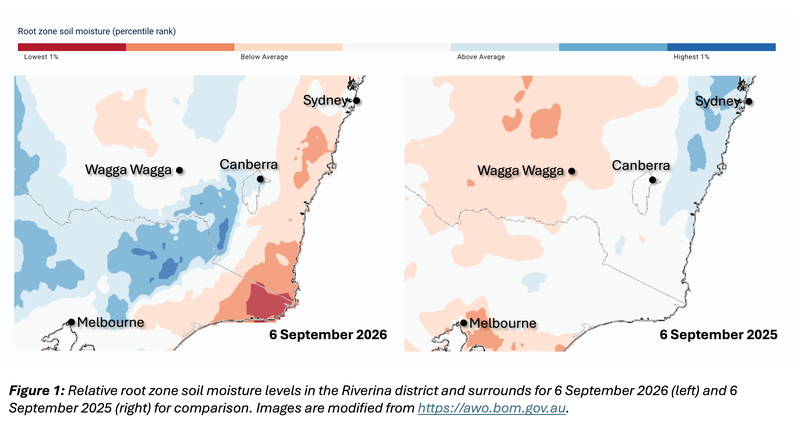
The most important difference is the amount of water now available through the root zone. In early September 2025, much of the district was below average and had less stored moisture available to support spring growth. This year, grasses are beginning spring from a much stronger position.
Even if rainfall becomes less frequent during September, moisture already held in the soil may continue to support grass growth through the early flowering period. The critical question is how quickly warmer spring temperatures draw down that moisture.
Vegetation Greenness and Growth Potential
Satellite imagery showing vegetation greenness, known as the Enhanced Vegetation Index or EVI, indicates that the Riverina is noticeably greener than it was at the same time last year (Figure 2).
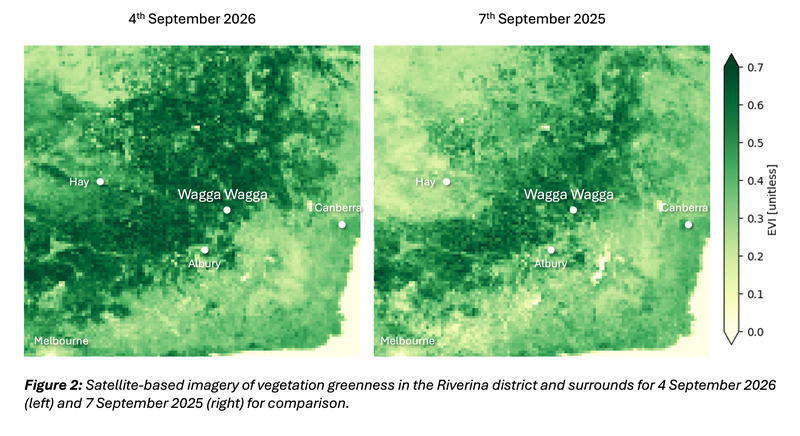
The strongest increases in greenness are visible across broad areas around Wagga Wagga, Albury and west towards Hay. These areas contain extensive pastures, roadsides and agricultural land that can contribute grass pollen to the surrounding air once flowering begins.
The difference is important because vegetation greenness provides an indication of how much actively growing plant material is present across the landscape. The 2026 imagery suggests there is substantially more biomass available to produce pollen once grasses begin flowering.
This stronger growth also means that the eventual size of the pollen season may no longer depend entirely on further spring rainfall. Rain would help sustain continued growth, but much of the early development has already occurred.
Climate Drivers and the Rainfall Outlook
A strong El Niño is now established and is expected to intensify further through spring. The Indian Ocean Dipole, a climate pattern in the tropical Indian Ocean that can influence rainfall across south-eastern Australia, remains neutral. Bureau models continue to suggest that it could become positive during spring, although the predicted strength of any event has decreased in recent forecasts.
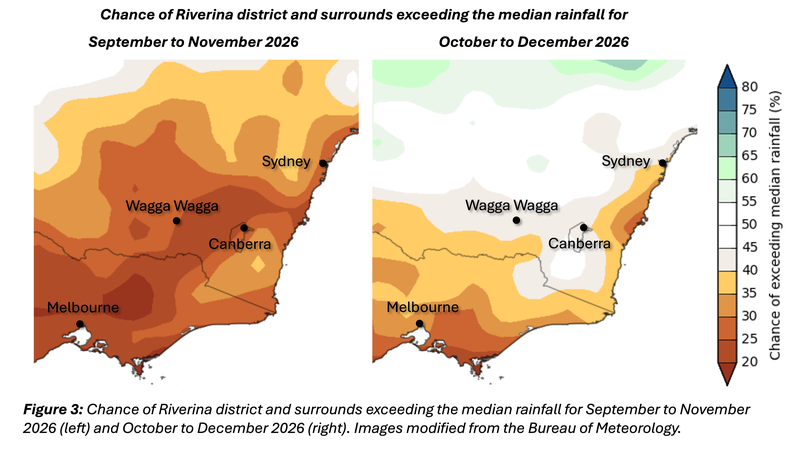
The Bureau’s local long-range rainfall outlook provides the clearest indication of what is expected across the Riverina (Figure 3). For September to November, the Bureau is predicting that the chance of exceeding median rainfall is well below 50% across most of the district, with a particularly strong dry signal around Wagga Wagga, Albury and Canberra. The outlook becomes closer to neutral for October to December, particularly around Wagga Wagga, although below-median rainfall remains more likely across parts of the southern Riverina.
Daytime and night-time temperatures are also likely to be above average, increasing the likelihood that soils and vegetation will dry as spring progresses.
What This Means for the Season Ahead
A drier outlook does not necessarily mean a low pollen season. The key question is when the dry conditions arrive and how long the dry conditions remain in place. Soils are already much wetter than last year, and the landscape is considerably greener.
If soil moisture supports continued growth through September and into early October, grasses may have enough time to build further biomass and begin flowering before hotter conditions dry the landscape. Once flowering begins, warm, dry and windy weather can support the release and movement of pollen through the air.
However, if unusually warm conditions arrive early and the landscape dries rapidly during September, grass growth and flowering may be cut short. This could reduce the size or duration of the pollen season despite the strong conditions already in place.
The next six to eight weeks will determine how much of that potential is realised. The evidence available early September points to a season that people across the Riverina should take seriously.
- “The Riverina could be heading for a much bigger grass pollen season than last year,” said Dr Edwin Lampugnani, CEO of AirHealth, which operates the AirRater service.
- “The key is timing. Wetter soils and stronger green growth have given grasses a head start. If that moisture lasts through September and into flowering, Wagga Wagga, Albury and surrounding communities could see significant amounts of grass pollen in the air. People with hay fever and asthma should start preparing now.”
How to Prepare
With the potential for a more active grass pollen season, it’s important to start preparing early. If you experience hay fever or asthma, take time now to review your treatment plan and make sure your medication is up to date.
- “Pollen season is a good reminder to check in on your asthma. Make sure your medicines are right for you, your inhaler technique is correct and your written Asthma Action Plan is up to date. A review with your doctor can help identify problems before they become an emergency,” said Kate Miranda, CEO, Asthma Australia.
To prepare for the weeks ahead:
- * Check daily pollen forecasts on the AirRater App (available on Apple and Google App stores).
- * Talk to your GP or pharmacist about managing symptoms before they start.
- * If you have asthma, make sure your Asthma Action Plan is current and medications are accessible.
- * Avoid being outdoors on high pollen days, especially before thunderstorms or during windy conditions.
- * Pay particular attention to pollen forecasts when storms are expected, as certain storm conditions can increase the risk of sudden asthma symptoms when grass pollen levels are high.
The Bottom Line
The 2026 grass pollen season in the Riverina has the potential to be more active than last year. Soils are much wetter than they were in early September 2025 and a noticeably greener landscape has already supported substantial vegetation growth.
The main uncertainty is how quickly spring conditions become hot and dry. If soil moisture carries grasses through September and into flowering, the Riverina could experience a much bigger season, with significant amounts of grass pollen in the air during October and November. If the heat arrives early and the landscape dries rapidly, the season may be shorter or less intense.
Either way, the conditions already in place mean people with hay fever and asthma should begin preparing now.


© 2010- AirHealth Pty Ltd and Western Sydney University. All rights reserved.
This information is copyrighted (Terms & conditions). Apart from any use as permitted under the Copyright Act 1968, no part may be reproduced by any process without prior written permission. This includes all pollen information and forecasts.